
Show results for
Deals
- 4K Ultra HD Sale
- Action Sale
- Alternative Rock Sale
- Anime sale
- Award Winners Sale
- Blu ray Sale
- British Music Sale
- British Sale
- Classical Music Sale
- Comedy Sale
- Country Sale
- Criterion Sale
- Cult Films sale
- Drama Sale
- Electronic Music sale
- Horror Sci fi Sale
- Jazz Sale
- Metal Sale
- Music Video Sale
- Musicals on Sale
- Mystery Sale
- Naxos Label Sale
- Rap and Hip Hop Sale
- Reggae Sale
- Rock
- Rock and Pop Sale
- Rock Legends
- Soul Music Sale
- TV Sale
- Vinyl on Sale
- War Films and Westerns on Sale

L'organo Manzoni 1891 di Bienno
- Format: CD
- Release Date: 4/26/2024
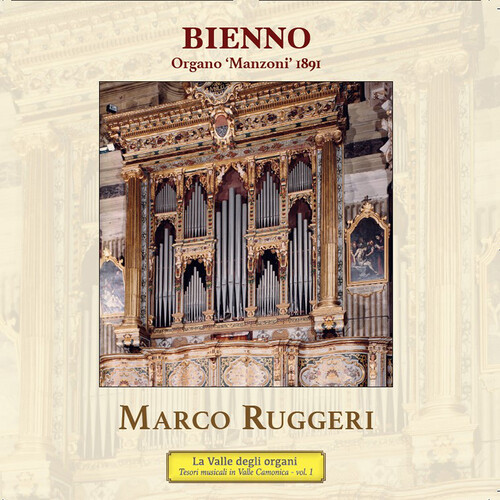
L'organo Manzoni 1891 di Bienno
- Format: CD
- Release Date: 4/26/2024
- Composers: Costanzo Antegnati, Davide Da Bergamo, Georg Bohm, Johann Sebastian Bach, Johannes Brahms, Louis Vierne, Marco Enrico Bossi, Theodore Dubois, Wolfgang Amadeus Mozart
- Label: Mvcremona
- UPC: 8032632230649
- Item #: 2635815X
- Genre: Classical
- Release Date: 4/26/2024
CD
Price: $18.99

Get it between
Thu. Aug 27 - Fri. Sep 11
Deliver to
Product Notes
The Italian organist Marco Ruggeri offers in this CD a compilation of pieces by various author, chosen to enhance the acoustic
qualities of the wonderful historical organ of the church of SS. Faustino and Giovita in Bienno. It dates back to around 1630. At that period Graziadio IV Antegnati (1608-1657) creates a 16-foot organ with an enharmonic keyboard with certainly 4 and possibly 5 broken keys for the Benedictine monks running the parish. In 1750 the instrument is restored, moreover, the organ choirs are replaced with others of a typically Baroque style while the organ case is preserved. Antegnati's organ still exists in 1822 when the scholarly Giacomo Simoni sends one of the Serassi brothers to Bienno recommending that all recoverable Antegnati material must be preserved, yet no agreement is reached. A few years later, an unknown organ builder adds typically 19th-century stops. Finally in 1891, according to the 1881 project, the organ builder Giovanni Manzoni of Bergamo, who had previously worked with Bossi and for a short time with Perolini brothers, restores and expands the organ. He initially works out a two-manual project, later he reduces the instrument to a single keyboard with 47 stops and 1823 pipes. The new structure includes also the 155 Antegnati pipes scattered in different stops, as well as 18 Principale pipes in an almost perfect succession and they confirm the original division. The latter group is moved to the 'organetti morti' (pipes placed in the upper part of the facade). The seventeenth-century case is totally preserved. In 1943 Armando Maccarinelli from Brescia carries out an extraordinary maintenance and remixes some stops. In 1961 Emilio Piccinelli of Ponteranica - without knowing Manzoni's project, found in the parish archive only years later - makes a radical restoration yet very respectful of the 1891 physiognomy. In 2017/2018 the Piccinelli family carries out a philological restoration bringing back the instrument to the exact conditions of 1891, on the precise indications from the Milan 'Servizio Tutela Organi'. The intervention is completed for the larger part by rearranging the pipes, recovering the material set aside and only with the reconstruction of 12 pipes of Cello.