
Show results for
Deals
- 4K Ultra HD Sale
- Action Sale
- Alternative Rock Sale
- Anime sale
- Award Winners Sale
- Blu ray Sale
- British Music Sale
- British Sale
- Classical Music Sale
- Comedy Sale
- Country Sale
- Criterion Sale
- Cult Films sale
- Drama Sale
- Electronic Music sale
- Horror Sci fi Sale
- Jazz Sale
- Metal Sale
- Music Video Sale
- Musicals on Sale
- Mystery Sale
- Naxos Label Sale
- Rap and Hip Hop Sale
- Reggae Sale
- Rock
- Rock and Pop Sale
- Rock Legends
- Soul Music Sale
- TV Sale
- Vinyl on Sale
- War Films and Westerns on Sale

Mahler & Zemlinsky: Symphony No. 6
- Format: CD
- Release Date: 10/16/2026
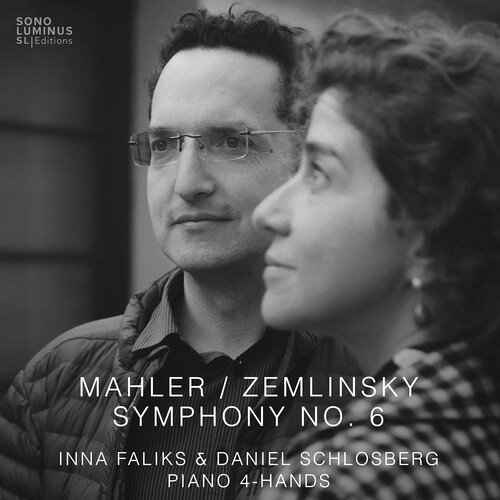
Mahler & Zemlinsky: Symphony No. 6
- Format: CD
- Release Date: 10/16/2026
- Composers: Gustav Mahler
- Label: Sono Luminus
- UPC: 053479705006
- Item #: 2838476X
- Genre: Classical Artists
- Release Date: 10/16/2026

Product Notes
By the mid-19th century, the burgeoning piano industry was in full flower, incorporating many developments and improvements in design. This led to increased consumer demand and mass production. Consequently the piano evolved from being a luxury item to home entertainment center. Until the advent of radio and recordings, this was how you experienced music at home. Apart from traveling to concerts, the only way to get to know, say, a new Brahms Symphony or the latest Wagner or Verdi opera was to play them at the piano, more often than not in arrangements for one piano four hands.
Glancing through myriad music catalogs (not to mention IMSLP), it seems that nearly every symphony, string quartet, choral work and opera had once been available in duet arrangements. Most publishers employed staff arrangers for this task; indeed, one could find certain works in more than one or two editions, such as the Beethoven Symphonies. Composers like Liszt, Brahms, Smetana and Dvorak either made their own four hand arrangements or else supervised others to do so. In essence, the piano duet medium represented the most viable way to dissemenate new orchestral works, particularly those for which concert performances were few and far between. One case in point concerns Bruckner's 1877 reworking of his Symphony No. 3. Although it had little success, that didn't stop the 18-year-old Gustav Mahler from transcribing it for piano duet for what is considered to be Mahler's first publication. In turn, Mahler's disciple Bruno Walter arranged Mahler's First and Second Symphonies for four hands. And Alexander von Zemlinsky, another close member of Mahler's inner circle, unveiled his four-hand version of the Sixth in 1906. Born in Vienna on October 14th 1871, Zemlinsky played both piano and organ from a young age, and was admitted to the Vienna Conservatory in 1884 where he studied piano and composition. Brahms apparently was impressed by Zemlinsky's Clarinet Trio (1896), while Mahler himself conducted the premier of Zemlinsky's opera Es war einmal at the Vienna Hofoper in 1900. That same year he made the acquaintance of the 21-year-old aspiring composer Alma Schindler. Their initial teacher/student relationship soon evolved into a turbulent love affair that lasted until the following year when Alma met Mahler, whom she eventually married. Mahler composed his Sixth Symphony between 1903 and 1905, but continued to make adjustments until his death in 1911. He conducted it's world premiere at Essen on May 27th 1906. Out of all of his purely instrumental symphonies, the Sixth is scored for the largest and most varied assortment of instruments. Although Mahler did call this symphony 'Tragic,' he did not designate an official title. Yet the music indisputably embodies the classic Greek idea of tragedy in the futility of one's heroic striving against an inevitable fate. As such, it's the only one of Mahler's symphonies that concludes neither happily nor peacefully. The opening bars introduce the driving march rhythm that loom large throughout the symphony. A chorale-like theme leads into the passionate F Major second theme that Alma claimed to describe her. Not all conductors (nor Faliks and Schlosberg) observe Mahler's indicated exposition repeat, a convention that had long been considered as optional. The development section subjects the themes to elaborate and compact contrapuntal interplay. While one misses the spatial impact of cowbells against soft celesta chords accompanied by high triple-piano violin tremelos, Zemlinsky compensates with equally compelling keyboard textures and pedal effects. Mahler never made up his mind about the order of the two middle movements. His manuscript and first published score places the Scherzo before the Andante, although his performances opted for Andante-Scherzo, which is reflected in the 2003 critical edition. In any event, listeners can program this release to suit their own preferences. In addition to reiterating the motto march motive, the Scherzo stands out for it's quirky and highly original dance sequences. The Trio, marked 'Altvaterisch' ('in an old-fashioned style'), features irregular rhythms and off-beat accents that, according to Alma's memoirs, represent 'the arhythmic games of (our) two little children, tottering in zigzags over the sand. ' Somehow the third section dance's woodwind squeals and col legno string effects prove just as grotesque and menacing via Zemlinsky's piano scoring. By contrast, the Andante provides the Symphony's only sustained point of respite, alternating between two of Mahler's longest and most heartfelt melodies. As writer David Hurwitz astutely explains in his Mahler Symphonies 'Owner's Manual,' the Finale's ambitious dramatic trajectory takes place in four distinct musical zones, each with it's own specific atmosphere: 1) the familiar march elements, 2) the surging lyrical tunes, 3) the introspective pastoral passages and 4) a 'twilight zone' full of terror and mystery. With Mahler's encouragement, both Zemlinsky and Schoenberg founded the Vereinigung schaffender Tonkünstler (Alliance of Creative Musicians) in Vienna in 1904 to promote and disseminate new works. One outcome of the organization was Zemlinsky's four-hand arrangement of the Sixth, which he and Mahler played in Schoenberg's presence. The performance may well have planted the seeds for Schoenberg founding his Verein für musikalische Privataufführungen (Society for Private Musical Performance) in 1918. Under Schoenberg's supervision, Zemlinsky's arrangement was performed twice at the Society by pianists Eduard Steuermann and Ernst Barich. In his biography of Mahler, Erwin Ratz wrote that 'The performance. Was a highlight in the concerts of the Society. In about thirty rehearsals Schoenberg had prepared the performance with loving care. In retrospect it may be said that the four-handed rendition bears equal comparison with the performance of the original version. ' Naturally 88 piano keys cannot replicate the visceral impact of Mahler's unprecedented orchestration and his genius for instrumental color. However, since Mahler's orchestral original is ubiquitous in concert and via recordings, one should welcome this opportunity to experience Mahler's Sixth in a relatively unfamiliar yet fresh and authentic light. As Inna Faliks and Daniel Schlosberg cogently reveal in this remarkable recording, the music works well on the piano. In purely keyboard terms, Mahler's contrapuntal acumen and rich harmonic language make a pointed, intimate and idiomatic impact, losing little in translation. Moreover, two pianists sharing one bench can respond with unusual flexibility and immediacy to the music's harrowingly wide emotional gamut, channeling the spirit of Zemlinsky and Mahler hovering over the keyboard when the ink had barely dried on the page. - Jed Distler